Will You Turn the Parlour Off? He Asked. "That's My Family."
Episode 7: 'I Was The I' 36:51 Re-create the code beneath to embed the WBUR audio player on your site
Re-create the code beneath to embed the WBUR audio player on your site
Play
The pieces that thieves stole from the Isabella Stewart Gardner Museum in 1990 don't quite add up. Some were masterpieces, some were sketches, and others were, well, not similar the others. Two major outliers — the eagle finial and the Chinese bronze gu — are more probable to be "trophy steals."
Just "trophy steals" for whom? Well, perchance for infamous Boston fine art thief Myles Connor.
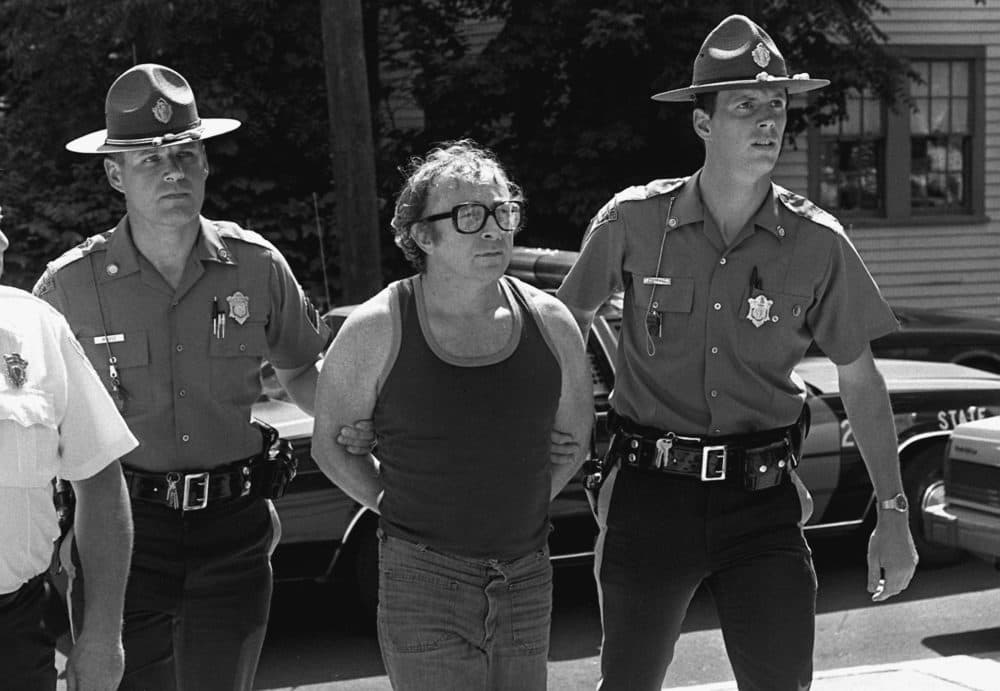
Connor was raised in Milton, Massachusetts, to a family mix of blue bloods and blueish neckband. Extraordinary smart, Connor chose to pursue a stone 'northward' roll career instead of a Harvard caste. By the mid-'70s, Connor showed his prowess at outsmarting law enforcement. You might go as far to say he wrote the playbook for how to steal a Rembrandt, and — more importantly — what to do with it once you have information technology.
In 1974, he and associate Bobby Donati robbed a Maine mansion of a haul that included five Wyeth paintings. They stashed it and so waited a few weeks for a buyer. That heir-apparent concluded up being an FBI amanuensis prepared with handcuffs for Connor. Out of jail and facing a long prison sentence, Connor stole a Rembrandt from the Museum of Fine Arts in Boston. While he was in jail, he bundled for a return of the artwork to authorities through a friend. Facing upward to 13 years in prison, he only served 28 months.
Now 73 years old, Connor says he started casing the Gardner Museum with Bobby Donati back in 1975. His plan looks a lot similar what actually happened — he wanted to go for the Vermeer and the Rembrandts, and option up the gu as a present for himself and the finial for Donati. After stealing the fine art, he'd ransom it back for the advantage coin.
But, Connor couldn't accept been inside the Gardner in 1990. He was in prison at the time of the theft, serving a long federal sentence for drug trafficking. Simply, could he have served every bit inspiration for the heist? Was he the mastermind?
Subscribe to our newsletter for the latest updates, bring together our Facebook group to discuss the investigation and if you have a tip, theory or thought, nosotros desire to hear it.
This episode was adapted for the web by Amy Gorel.
Transcript:
KELLY HORAN: Why did the Gardner thieves accept those 13 pieces? The answer to that question could tell u.s. and then much. Two in item seem to make no sense: the 12th century Chinese gu and the statuary eagle finial. They're not even one-of-a-kind. The museum's former director told u.s.a. she e'er thought of them every bit "trophy steals." Simply trophies for whom? Every bit information technology turns out, maybe this guy.
MYLES CONNOR: Back so there was a tree, where you lot could climb the tree and overlook and see into the Gardner. Get the routine of the guards and that sort of affair.
HORAN: At 73 years onetime, Myles Connor Jr. isn't climbing trees anymore. But as a beau, he studied martial arts. He was the kind of thief who could — and did — shimmy up a bleed pipe in order to rob a museum. Connor wanted to rob the Gardner Museum. He says he would have gone for the Vermeer and the Rembrandts, and his plan for doing it looks an awful lot like what really happened.
CONNOR: And so, I figured, I knew that the paintings were uninsured, and I knew they would practice anything to get their paintings dorsum. And then it made sense that they would come up with a substantial reward for a return of those things. And that, that was my programme for the Gardner.
HORAN: Steal the art. Ransom information technology back. Myles Connor says he started casing the Gardner Museum in 1975, a full 15 years earlier the heist. And as he walked the galleries back then, he says he wasn't solitary. He was with another art thief, a guy named Bobby. Not a Bobby we've told y'all almost though. His proper noun was Bobby Donati.
CONNOR: Bobby was a typical, Italian cheat. I wouldn't call him a mobster because mobsters are what you associate with organized crime. He wasn't that kind of a crook. His specialty was rugs, oriental rugs. That's what he used to steal, deal with and collect.
HORAN: Connor and Donati had eclectic taste. Lucky for them, the Gardner has an eclectic collection. So after setting their minds on the museum'southward Dutch masterpieces, which Connor says they intended to bribe back for the advantage, they window-shopped for a little something overnice for themselves.
CONNOR: When Bobby and I had gone through the Gardner, for some reason he was attracted to the finial. He said, "I similar that." And sure enough it was taken. Then there was a bronze — didn't they take a Chinese bronze urn?
HORAN: Connor is referring to the gu. He'due south a cocky-taught addict of Asian art.
CONNOR: [Laughing.] That was something that I liked! I'm embarrassed to say! I never should have admitted that! But I'm damn certain he took that considering I told him that I liked information technology. He liked the finial. I said I similar that matter.
HORAN: Did Bobby Donati current of air upwardly with that finial? Were Bobby Donati and Myles Connor responsible for the heist? Nosotros put the question to the Gardner Museum's head of security, Anthony Amore.
ANTHONY Affection: I don't similar to speculate nearly who did it, where they are, just there are things I volition throw out there. And ane of my beliefs is that it's probable that Myles Connor was the inspiration for the heist. Right? Because it's hard to believe he wouldn't exist given how prolific he was in the decades leading up to it.
HORAN: Amore describes Connor as the world'due south greatest fine art thief. He wrote the playbook for how to steal a Rembrandt, and — more important — what to practice with it once you have it. The question is: Was Myles Connor more just the inspiration for the Gardner heist? Was he the mastermind?
From WBUR Boston and The Boston World, this is Terminal Seen. I'm Kelly Horan.
JACK RODOLICO: And I'one thousand Jack Rodolico. This is Episode 7: "I Was The One."
Myles Connor was born in Milton, Massachusetts, a comfy Boston suburb. His family stretches back to both sides of the city's oldest class divide: blue neckband and blue claret.
CONNOR: My male parent was a Milton police officer. My female parent was a daughter of the Mayflower.
RODOLICO: By the way, Connor slurs his words a little — the result of major heart set on he suffered a few years ago. He traces his lineage on his mother'due south side to a founder of the Hudson River School of artists. He traces his criminality to his paternal grandfather, who fled Republic of ireland afterwards he shot a constable. He says the first museum he ever robbed was an deed of revenge in the name of his father. Here'southward what happened: A small museum in his hometown accused Connor'southward male parent — the cop — of stealing from them, something his dad would never do.
CONNOR: So my father who was as honest equally honest could be. And he said, "Tin can yous believe that these WASP sons of bitches? Y'all know, I've never been and so insulted in my life." And then, I picked up on this.
RODOLICO: And by picked upwardly on this, Connor means he got even. He snuck into the museum at dark and took plenty antiques to fill the torso of his car. He gave the museum just plenty fourth dimension to panic earlier all of it showed support on their front backyard.
CONNOR: The stuff was mysteriously returned to the museum! [Laughs.]
RODOLICO: This sort of I-can-do-annihilation-at-any-fourth dimension attitude, it stems from the fact that Connor pretty much could take done anything with his life. Before he became the best at a bad thing, he had the option of becoming actually good at proficient things. Connor was an exceptionally bright kid. He says he was offered a spot at Harvard, where he would accept studied to get a surgeon.
CONNOR: That was a plow in my life that I regret. Looking back at it, I recollect I would accept been a better surgeon than I was an art thief.
RODOLICO: Simply he didn't give upwards on existence a surgeon and then he could be a thief. He rejected college to pursue some other passion altogether. Myles Connor was a rockstar. Here he is, on phase, at a place chosen the Beachcomber in Quincy, Massachusetts, in 1978.
[Music]
RODOLICO: His band was called Myles Connor & The Wild Ones. He headlined clubs around Boston, and opened for big names, like Roy Orbison and Chuck Berry. He was a v-foot, ii-inch front man with a leather jacket and fiery ruby-red hair. Sometimes he drove his motorcycle right on stage. And he could impersonate stone legends. A local chain of gas stations hired him to tape their commercials, where he'd imitate his heroes. Here's one from 1963.
[Music]
HORAN: Connor's music career was bound to endure as crime took up more than and more of his time. Martin Leppo is the defence force attorney who's represented vii dissimilar men who have been named in connection to the Gardner investigation. Myles Connor is ane of them.
MARTIN LEPPO: Have I been out socially with Myles? Absolutely. Has he been to my house? Absolutely. Has my married woman cooked dinner for him? Absolutely. Did I write to him while he was in jail? Absolutely. Did I defend his honour in certain things? Absolutely. Do I think he'southward a criminal? Absolutely. But a very bright criminal, and if he had washed things the right way, he would have probably been some famous surgeon or politician.
HORAN: Connor was a Renaissance criminal. He'd kidnap drug dealers, stick up banks, sell cocaine — you name it. And he doesn't exactly look back on all his crimes with remorse.
CONNOR: Got picked up with about $100,000 cash on me! Simply information technology was unmarked cash. ... Bang! I hit the guy. [Laughing hard.] And then he goes down. Now a fight breaks out. It's all of them against me. Information technology's the unabridged goddamn football squad.
LEPPO: He was taking downwardly Quaaludes from Canada. He was making effectually 20,000 bucks a week.
CONNOR: And so the guy says, "I know who you are." And I say, "I don't think so. I don't know yous." "Oh yes, you do. You little f----- punk, you mother f-----." Blam! I label him correct across the top of his skull. He was an off-duty Boston cop. He was the showtime cop I ever nailed. ... A shotgun goes off. Ba-lam! Shoots himself right in the assurance. And so nosotros're all stunned! "Oh! I shot myself!" Could not have happened to a more deserving individual. [Laughs.]
HORAN: The criminal offense Connor is all-time known for, though, is stealing art. And he says the question of who he would and wouldn't steal from was all downwardly to a personal lawmaking. A kind of thief's honor system. Have the fourth dimension he posed as a well-dressed gentleman, and talked his mode into the storage area of a museum with vast holdings of Asian antiquities. Connor says he could take cleaned them out.
CONNOR: But I recognized their deep sense of amore towards the stuff that they, that they had. It was that sense of appreciation that kept me from violating the trust that they had.
HORAN: Connor felt no such compunction most the prospect of stealing from the Isabella Stewart Gardner Museum.
CONNOR: They were going to become the paintings back! I was gonna get money! And then at that place was no damage done other than to the insurance company or the billionaire patrons.
HORAN: Myles Connor isn't just smart. He claims membership in Mensa, the high-IQ society. And his genius is best on display when he is getting himself into and out of problem. That's his art. And it was a crime spree in the mid-1970s that solidified his reputation as someone who could outfox law enforcement.
CONNOR: When y'all steal something from a major museum, and you don't accept it out of storage, and it'southward going to be missed, then the major purpose is to apply that as a bargaining chip to help either oneself or somebody else out of a "jackpot."
RODOLICO: Hither's how Connor got himself into what he calls a "jackpot." In 1974, Connor says his old buddy who liked antique rugs, Bobby Donati, approached him about an estate he wanted to rob in Maine. It was owned by the Woolworth family, who had a private drove that rivaled an art museum.
CONNOR: I was not in the business of stealing some private collection from somebody who had a deep attachment to it. But somebody who had as much money as those folks had, and could go away for half a year at a time, that actually didn't bother me. Then I went along with Bobby.
RODOLICO: For a leisurely hr in the middle of a warm summer dark, Connor and 3 other men — including, he says, Donati and a guy named David Houghton — combed through the empty mansion. They filled a panel truck with two Simon Willard grandfather clocks, ii paintings by Andrew Wyeth and three more by his father, N.C. Wyeth. I was an illustration the elderberry Wyeth had painted for the original cover of the book "Treasure Island." Connor says he stashed it all and waited weeks for Bobby Donati to announce he had found a buyer for the paintings. Connor met up with that buyer on Cape Cod.
CONNOR: I ended upward taking the paintings downwardly there, and met these FBI agents. Information technology was a sting performance and I got arrested for interstate transportation of stolen goods.
RODOLICO: Connor was staring at a long prison sentence — possibly 10 years for trafficking the art, three more than for violating parole. He was 31 years old. For the FBI, arresting Connor red-handed — that was the jackpot. Because he'd always managed to get away. Like the time he was on the lam when his mother died. Martin Leppo says Connor knew the police would stake out the funeral abode looking for him, and he was determined to see his female parent one last time.
LEPPO: He actually rented a hearse, got into a bury transported to the funeral parlor. Got out, kissed his mother bye, got back in the bury into the vehicle and left.
HORAN: Which, brings us back to that parking lot in Cape Cod, where Connor was nabbed with the five stolen Wyeth paintings. The FBI had him. He knew it. They knew it. And, according to Connor, the agent who arrested him rubbed information technology in his confront.
CONNOR: And he said, "We've got yous now, Connors. Information technology'll take a Rembrandt to get you lot out of this." I said, "You know, y'all're correct." And so then I set my heart on getting a Rembrandt.
HORAN: Myles Connor, out of jail and awaiting trial for trafficking the stolen Wyeths, heeded the Rembrandt advice. He simply had to find i. He settled on one that was on loan to the Museum of Fine Arts, Boston: "Portrait of Elisabeth van Rijn," Rembrandt's sister. At the fourth dimension — 1975 — it was said to be worth upwardly of a 1000000 dollars.
CONNOR: That particular painting was about the dorsum entrance to the place so you could get a quick access, and a quick egress.
HORAN: Connor hatched a broad daylight robbery. This posed a few issues, not to the lowest degree of which was Connor'due south budding notoriety every bit an art thief — his name was all over the papers for the Wyeth arrest. Plus, that red hair.
CONNOR: I believe I had a tan trench coat, a wig and sunglasses. And I believe I also had a faux mustache.
HORAN: On a sleepy Monday — April fourteen, 1975 — Connor launched what sounds like a paramilitary strike on Boston'south MFA. Connor says at that place were iii vehicles with 8 armed men, one with a automobile gun. Six men positioned themselves near the archway while Connor and some other thief, besides disguised, bought admission tickets, and walked up to the gallery on the second flooring. They pulled the Rembrandt off the wall and ran.
CONNOR: As the leave was made down the front steps there was a phalanx of guards that came rushing down.
HORAN: Connor says as he ran through the turnstile with the painting, the corner of the portrait's frame jammed between the confined. Information technology wouldn't budge. Connor was stuck. The guards closed in. An accomplice opened fire.
CONNOR: And there was a guy with a machine gun, brrrrr. Allow the motorcar gun go off. They went right dorsum.
HORAN: The guards stood downwards. Connor, with the help of one of his men, pushed all of his weight against the turnstile. Equally he freed himself, the corner of the Rembrandt's frame croaky and splintered. The thieves ran with it to the van. One baby-sit chased them.
CONNOR: The guy would non let become of the painting. The guy ran up to the dorsum of the van and latched onto the painting.
HORAN: "Don't shoot the guard," Connor said. One of them smashed him in the head with the barrel of a gun. The baby-sit, a retired cop, collapsed in the street as they sped away with the Rembrandt.
RODOLICO: Imagine the pressure the Boston police and the FBI were nether to catch the thieves who stole a Rembrandt in the center of the day. The investigation dragged on for months without a break. But there was ane person who knew exactly what happened.
AL DOTOLI: And so when I woke upwards and plant that information technology was gone, I knew right abroad. I said that's what's been going on. He stole the damn Rembrandt.
RODOLICO: Al Dotoli is Myles Connor's oldest and best friend. He is non a criminal. Dotoli is a police force-constant music production manager. The two met as teenagers when Connor was a music legend in their neighborhood. At 15 years erstwhile, Dotoli knocked on Connor's door and asked for a guitar lesson. Almost 60 years later, Dotoli is however loyal to his friend but that doesn't mean he understands his choices.
DOTOLI: Yous know, I was never scolding him, merely I said, "For Christ'due south sake, don't you e'er end?"
RODOLICO: Of grade, Connor didn't stop. And as law-breaking derailed his music career, Dotoli moved on with his own, producing bigger and bigger acts. He's ready sound systems for Aretha Franklin, Dionne Warwick, the Dalai Lama and Super Bowl halftime shows.
DOTOLI: I came off a plane. I was with Dionne Warwick. And we're walking off the plane. He had merely been shot robbing a freaking bank a couple weeks earlier. And he's in a wheelchair with a cast on up to his hip, from the foot to the hip. I'm coming down, and I get, "Oh, my god."
RODOLICO: Here's the kind of friend Al Dotoli is: When Connor would go to prison, Dotoli arranged concerts behind bars, Johnny Cash-fashion. Like in 1977, when he got dejection legend James Cotton wool to perform with Connor in Walpole Land Prison house. Here'southward that recording.
[Music]
RODOLICO: Information technology was this friendship and loyalty that made Al Dotoli the obvious person to shake down for information about the Boston MFA's missing Rembrandt. Boston law, the FBI, fifty-fifty insurance agents were knocking on his door. One evening, a black limousine pulled up. Out stepped a nightclub owner, carrying a briefcase.
DOTOLI: He sits downwardly and goes, "Well you know, the guys — the guys on the colina thought maybe Myles would consider letting us deal this Rembrandt that he seems to have absconded."
RODOLICO: "The Guys on the Hill" — that was the underworld euphemism for the dominant Patriarca crime family.
DOTOLI: And he takes the briefcase, and he opens it up, and information technology's jammed full of money. And so I see that. He thinks information technology'due south gonna jolt me to get something done. Well, that's most equally close every bit I ever came to wetting my pants. And so I went to Myles and I said, "OK, this s--- has to stop. Correct at present. This is information technology."
RODOLICO: Dotoli had no thought where the Rembrandt was. No one knew that except for Myles Connor — and a friend of his, a guy they referred to as Charlie, who didn't enquire a lot of questions.
CONNOR: In this instance it went under the bed of a friend of mine's grandmother. [Laughs.] And and then she never knew what was underneath her bed. There it stayed, safe and sound, condom and sound.
RODOLICO: Non and then much for Connor. Less than two weeks after the Boston MFA heist, he was due in court for trafficking the Wyeth paintings. He skipped the trial, which fabricated him a fugitive. Through the summer of 1975, Connor was in hiding — until the FBI caught him. Once again. Only this time, Connor had his get-out-jail-free card: the Rembrandt. Except, at present that he was in prison, he couldn't deal that card himself. Plus, would the FBI play?
CONNOR: FBI will say, "No. We're not going to deal with that guy. We don't care what we --- nosotros are non going to deal with that guy." And so that is always the position of the FBI. So you simply go beyond the FBI.
HORAN: What — who — is beyond the FBI? From his jail prison cell, Connor started with an old friend of his father's — a land police major named John Regan.
CONNOR: The major distinction between an FBI agent and a state police officer is a sense of humor.
HORAN: Deliberately cutting out the FBI, Connor, through the state police, offered the federal prosecutor a deal.
CONNOR: And they went to a federal prosecutor who wanted the publicity. So he said, "Oh, you tin can become the painting back? We'll do any he wants." And so I negotiated the return from Charles Street Jail.
HORAN: In a sense, that was the easy part. But for the prosecutor to reduce his sentence, Connor had to return the Rembrandt. To do that, he needed someone he could trust. Enter Al Dotoli.
DOTOLI: Myles beingness Myles, he starts with all this cloak and dagger shit on how he wants it washed. "Use firecrackers. Let them think they're auto guns," and I said, "Heed, mind, mind, I'll go this thing back to — you lot're sitting hither. I'm outside. It'southward going down my manner."
HORAN: Later on the black limo left his driveway, Al Dotoli was eager to run across the Rembrandt returned. He reluctantly agreed to do it.
DOTOLI: I just wanted to run across that moving-picture show of that Rembrandt on the front page of The Boston Earth saying it'southward been returned, then I could get rid of all those fools that were jumping in on my — you know, the insurance agents, and the FBI, and quite honestly, the underworld, and the mafia, and all those people would have no more reason to be, to be looking for me if, in fact, information technology was returned.
HORAN: I take to say you are a very tolerant friend.
DOTOLI: Yeah. You know, there'southward some tolerance, sprinkle in a picayune stupidity, and rock 'n' roll. It's not a skilful — it's not a good friction match.
HORAN: Connor says he wrote 2 letters with instructions on how the handoff should go. A friendly prison house guard hand-delivered them both — one to Charlie, who hid the painting, the other to Dotoli. Connor wrote to his friend: "This operation is vital and must be carried out successfully; no mob, no insurance men, no FBI or police, and no failure." No pressure.
CONNOR: Make sure it goes smoothen, and make certain the correct people are involved, and the wrong people aren't listening. Plus there's a sense of romance associated with the chance. So all of that plays into information technology.
HORAN: Jan. 2, 1976 was a cold, articulate Friday. From jail, Connor made the call that ready his loftier-stakes scheme in motion. He called Dotoli and said, "Tonight is the nighttime." Connor gave his friend a code proper name: Kevin.
DOTOLI: And I called Major Regan at his abode, and he answered, and I said, "This is Kevin and nosotros're on." And I said, "Arrive your car and drive to the Pepsi distributor, which is downward the street. At that place's a payphone at that place. Pull up and await for the telephone to ring and yous'll get your next marching society."
RODOLICO: Information technology was merely after 7 p.1000. From a room at the Holiday Inn, Dotoli called State Police Major Regan and gave him directions to the hotel. When Regan pulled in, Dotoli was waiting for him, in the shadows. He approached the machine and used the code language Connor had given him.
DOTOLI: I was to say to John Regan, "It's a prissy night out tonight." And the answer was going to be, "Yes, at that place's enough of stars." Then I said, "Aye, it's a nice night..." I'grand standing in that location all in black with a freaking ski mask on. And so, OK. So, I opened the door and I get in back. And this other gentleman is in the machine. Then I said, "IDs" And that's when I'chiliad saying, "You know, you lot're in pretty deep hither now."
RODOLICO: The guy in the car with Major Regan was the federal prosecutor who had the power to let Connor off the hook in the Wyeth instance. Dotoli sent them across the street into a disco. Through his ski mask, he told them to expect for the bartender to announce a phone call for a Paul Greeter. They went into the bar. A few minutes after, Charlie pulled upwards with the Rembrandt in his trunk.
DOTOLI: Myles had bundled, I had a photograph. Charlie had a photograph. And it was a photo of what's on the back.
HORAN: Of the Rembrandt?
DOTOLI: The Rembrandt, itself, just as importantly and fifty-fifty more importantly a bunch of numbers and things that were on the dorsum.
HORAN: During whatever of this, did you have a moment to interruption when you were belongings this Rembrandt in your hands and kind of behold what information technology was?
DOTOLI: If you're request me if the artistic value of it ran through my veins, no information technology didn't. What ran through my veins was, "Holy shit, this thing is finally hither, and hopefully soon it'll finally be gone."
RODOLICO: Dotoli put the Rembrandt in the trunk of Major Regan's car. He bolted up three flights of stairs to his room at the Vacation Inn, and called the disco.
DOTOLI: And the bartender goes, "Is there a Paul Greeter here?" I hear him become, "Aye, yep, yeah. I'1000 right here. I'm right here." So he takes the phone and I said, "OK guys, you walk out the front of that lounge. Walk, do not run." I said, "If what you want is in that trunk and so plow, confront the building, and put your hands into your chugalug." Earlier I said, "Nobody'due south armed, right?" They said, "Oh, no, no, nobody's armed." So they open up the torso and they're flashlighting all over the place. So they open their trench coats, they put their easily in there. And what I observed was: I went, "The sons of bitches." They both had a guns stuck in there.
RODOLICO: The country cop and the prosecutor left with the painting. Dotoli collection to the airport and flew straight to New York City for a gig. The next day, he picked up the newspaper.
DOTOLI: I read The New York Times. It wasn't on Page 1, simply it was on Page ii. And I was quite relieved.
RODOLICO: At a press conference announcing the return of the Rembrandt, the FBI was notably absent. Instead, the U.South. Attorney's Office and the State Constabulary proudly detailed the clandestine handoff. They stated plainly that they didn't make any deals with prisoners in order to get the painting back. Myles Connor, who was facing xiii years in prison house, only served 28 months.
HORAN: If Myles Connor could orchestrate the return of one Rembrandt from inside prison house, wasn't it possible he could organize the theft of another?
LEPPO: When the Gardner was hit, Myles became the No. ane suspect. Did he orchestrate it? And and then along and so on. So that was number i.
HORAN: In that location was just one problem, as Martin Leppo recalls. On March 18, 1990, Connor was serving a long federal sentence for drug trafficking. He was in prison in Lompoc, California. Then, Myles Connor didn't rob the Gardner Museum. Simply he says he knows who did. His erstwhile friend and erstwhile criminal cohort, Bobby Donati.
CONNOR: He was a pragmatist equally far as being a thief goes. So if somebody wanted to cut the paintings out of the frame, he'd do it.
HORAN: Recollect, Connor says he and Donati cased the Gardner together in the 1970s. The two had gone and then far, Connor says, every bit to pick out what they'd steal. And Connor's feat with the Boston MFA's Rembrandt had shown the entire criminal world that stealing fine art — especially a Rembrandt — was not only possible, information technology could get you out of prison house. Connor says Bobby Donati had an accomplice in the Gardner heist: David Houghton.
CONNOR: How I'm 100 percent sure that they did it was because David Houghton, who was longtime friend of mine, flew all the way from Logan Airport to California only to tell me: "Nosotros've done with. Nosotros did it. And nosotros got a agglomeration paintings, and we're gonna employ a couple of these paintings to deal you into a reduced sentence."
HORAN: If David Houghton were involved in the Gardner heist, he would have had to been waiting exterior — he weighed at least 300 pounds and bore no resemblance whatsoever to the police sketches of the thieves. What about Bobby Donati? With his round confront and dark features, possibly. But Connor is convinced that it was Donati and Houghton who stole the Rembrandts and the Vermeer as currency to jump him from prison house. And the smaller items they took ...
HORAN: So it sounds similar the finial was a gift for Donati.
CONNOR: Beyond a doubt.
HORAN: The gu was maybe a gift for yous.
CONNOR: [Laughs.] I'1000 quite sure. Yeah.
HORAN: If his friend took that gu as a souvenir for Connor, he says he never got it. That might be considering Houghton and Donati died the year afterwards the Gardner heist. Houghton had a heart set on; Donati was plant brutally murdered in the trunk of his car. The Boston FBI has said they know who robbed the Gardner Museum — and that the thieves are dead. They oasis't identified them. That could hateful that the secrets of the Gardner heist died with Donati and Houghton — or with any of the other dead men whose names accept been floated in connexion with the robbery.
Next calendar week, 1 more dead doubtable. His fingerprints were amidst the first sent to FBI headquarters after the heist. And some who knew him best believe he's still alive — and that he did it.
Last Seenis a production from WBUR and The Boston World. Digital content was produced in partnership with The Artery, WBUR'southward arts and culture squad. Read more on the Gardner heist from The Artery.
jenningsbounusposs.blogspot.com
Source: https://www.wbur.org/lastseen/2018/10/29/i-was-the-one
0 Response to "Will You Turn the Parlour Off? He Asked. "That's My Family.""
Post a Comment