Which Drawing Number Shows the Fondation Plan
The alchemist, intently hunched over his work in a dark, simple interior, single-mindedly focuses on his chemical experiment. With his felt hat pulled down firmly over his brow, he heats the fire in a small furnace by squeezing the bellows nether his arm. In this engaging painting, Bega provides a fascinating glimpse into the mysterious realm of an alchemist'southward workshop. He shows the alchemist in mid-experiment as he grasps metal tongs that reach into the fire, its blueish-gray fume billowing up behind the domed alembic. Below this drinking glass distillation vessel is an open-topped vessel containing the material to be distilled. The heated vapor rising into the hooded alembic cools on contact with its glass dome. The liquid created drips from the alembic's spout into a blood-red textile that filters it before it reaches a receptacle on the earthen floor of the workshop.
Thick tomes, their leather covers worn and torn, their pages, filled with drawings and instructions, rumpled from extensive utilize, lie within arm's accomplish. An illustration of this distillation process bearing an undecipherable, alchemical text, perhaps torn from 1 of these books, is attached to the stone wall direct higher up the oven.
According to Lawrence G. Principe and Lloyd DeWitt, Transmutations – Abracadabra in Art: selected works from the Eddleman and Fisher collections at the Chemic Heritage Foundation, Philadelphia, 2002, 17, this drawing resembles a woodcut that appears in various editions of the alchemical treatise Liber fornicum.
Bega's jar resembles an apothecary jar in the collection of the Rijksmuseum in Amsterdam, inv. BK-NM-10038. For an all-encompassing give-and-take of apothecary jars, come across the website of the Société d'Histoire de la Pharmacie, Paris, and especially the online commodity by Louis Cotinat, L'âge d'or des faïences d'apothicaires (1973), http://www.shp-asso.org/alphabetize.php?PAGE=pots%202
Silica was only discovered by Antoine Lavoisier in 1787, and the term "silicon" was beginning used in 1817 by the Scottish chemist Thomas Thomson. I am most grateful to Professor Lawrence M. Principe, Drew Professor of the Humanities, Department of the History of Scientific discipline and Technology and Department of Chemistry at Johns Hopkins Academy for identifying this inscription as "basilicon." The full inscription would most likely accept read: "U. BASILICON" or "UNG.BASILICON", where the abbreviation U. or Ung. stands for 'unguentum'. (correspondence with Henriette Rahusen, Baronial 8, 2014).
The alchemist'southward labors were intimately leap to the study and early practice of chemistry, and a huge literature evolved in the sixteenth- and seventeenth-centuries explaining the types of concrete matter and the processes by which i could comport experiments to transform one element into some other. It was, for many, a respectable profession, and its scholarly component is evident in the list of significant scientists —Bega's contemporaries—who sought to divide the essence of affair from its base of operations components, among them Robert Boyle (1627–1691) and Sir Isaac Newton (1642–1727).
For this history, see, amidst others, H.A.M. Snelders, De geschiedenis van de scheikunde in Nederland, part 1: Van alchemie tot chemie en chemische industrie rond 1900, Delft, 1993, xi-25; Lawrence M. Principe and Lloyd DeWitt, Transmutations – Alchemy in Art: selected works from the Eddleman and Fisher collections at the Chemical Heritage Foundation, Philadelphia, 2002; and Lawrence M. Principe, The Secrets of Alchemy. Chicago, 2013, especially chapter 5: "The golden age: practicing chymistry in the early modernistic period."
Alchemists conducted many chemical experiments, but the 1 that resonates nearly in the public consciousness was the try to turn base metal, such as lead, into gold. Most alchemists firmly believed that this elusive transmutation could be accomplished with the assist of the legendary and elusive "philosopher's rock" (lapis philosophorum), said to exist the 5th element (too h2o, air, burn down, and earth), which could separate the physical properties of elements through transmutation. Unfortunately, the quest for the philosopher's stone and, ultimately, for gilt led some alchemists astray and they would forget the underlying scientific components of their discipline. Instead, in their futile search for gaining riches through alchemy, some of them lost all of their worldly possessions and drove their families into the poorhouse. As a group they were often depicted equally fools and mocked for that futile quest.
Bega and his contemporaries were fascinated by abracadabra, a practice that occupied a realm somewhere between science and magic.
In 1663 Bega also painted The Astrologer (oil on panel, 36.9 ten 29.6; London, National Gallery, inv. NG1481), some other subject that occupied a realm that drew upon both scientific discipline and magic. For an excellent word of this painting, see the commentary by Savenaz Ayooghi in Peter van den Brink, and Bernd Wolfgang Lindemann, eds., Cornelis Bega: Eleganz und raue Sitten (Exh. cat. Suermondt-Ludwig-Museum, Aachen; Gemäldegalerie, Staatliche Museen zu Berlin), Stuttgart, 2012, 233-236, no. 66. 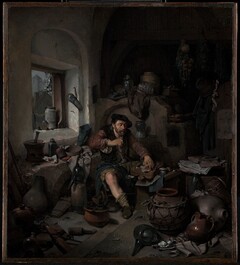 [fig. 1] Cornelis Bega, The Alchemist, 1663, oil on panel, The J. Paul Getty Museum, Los Angeles, inv. no. 84.PB.56. Digital image courtesy of the Getty'due south Open Content Program
Cornelis Bega, The Alchemist in his Workshop, 1661, oil on canvass (36 x 46 cm.), Gemäldegalerie Alte Meister, Kassel (stolen in 1945). For an analogy, run across Peter van den Brink, and Bernd Wolfgang Lindemann, eds., Cornelis Bega: Eleganz und raue Sitten (Exh. cat. Suermondt-Ludwig-Museum, Aachen; Gemäldegalerie, Staatliche Museen zu Berlin), Stuttgart, 2012, 243.
Several Haarlem artists from earlier generations, near significantly, Hendrick Goltzius (1558-1617) and Jacob de Gheyn (c. 1565-1629), did appoint in alchemical studies.
This concept is discussed by Jessica Korschanowski (Georg-August-Universität Göttingen) in a lecture at the Rijksdienst voor Kunsthistorische Documentatie (RKD), The Hague, 22 May 2014, "Between folly and erudition: The image of The Alchemist in seventeenth-century Dutch and Flemish genre painting."
The French edition (1580) of Guy de Chauliac's Inventarium Sive Chirurgia Magna (La Grande Chirurgie), originally published circa 1363, lists them every bit: cire (wax), mastic (resin, used in varnishing), verd de gris (verdigris, probable as a drying amanuensis), terebinthine (turpentine), litharge (atomic number 82 oxide, similar to massicot), and galban (resin). My gratitude to Elizabeth Berry Drago for the above information on the link between Basilicum and artists' materials, and for her insights into the widespread practical and commercial applications of proto-chemistry in the seventeenth century in full general.
For information on Bega'due south family, encounter Pieter Biesboer, "Cornelis Bega (Haarlem, 1631-1664). Eine Biografie," in Peter van den Brink, and Bernd Wolfgang Lindemann, eds. Cornelis Bega: Eleganz und raue Sitten (Exh. cat. Suermondt-Ludwig-Museum, Aachen; Gemäldegalerie, Staatliche Museen zu Berlin), Stuttgart, 2012, 25-26. Aside from Bega's begetter, who was both a gold- and silversmith, and a member of the Haarlem Saint Luke's order, Bega's uncle Sun Jansz Bagijn (died 1636) was a silversmith and sculptor; the blood brother of his paternal grandmother, Lord's day Fredericxz van Lijnhoven (1587-1637), was a noted silversmith, and his sis was married to the silversmith Cornelis Fransz Ebbekin, whose son Pieter Cornelisz Ebbekin (1622-1666) was also a silversmith. I would similar to thank Henriette Rahusen for emphasizing the importance of this family heritage in connection to Bega'due south involvement in proto-chemical science.
Aside from whatever interest in alchemy Bega may have gained from his family unit, the field of study clearly struck a chord in Haarlem, where a fertile market place for paintings of this subject must have existed. Aside from Bega, a number of other Haarlem painters, including Bega's master, Van Ostade 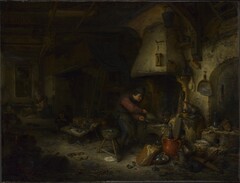 [fig. 2] Adriaen van Ostade, The Alchemist, 1661, oil on oak, National Gallery, London. Photograph © National Gallery, London / Art Resource, NY
 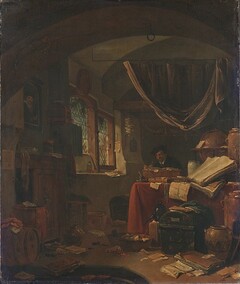 [fig. 3] Thomas Wijck, The Laboratory of an Alchemist, c. 1665, oil on panel, Museumslandschaft Hessen Kassel, Gemäldegalerie Alte Meister
Hendrik Heerschop (1626/1627-1690) was another Haarlem artist that painted scenes of alchemists. For one such work, come across David De Witt, The Bader Collection : Dutch and Flemish paintings, Kingston, Ont., c. 2008, 151, no. 88.
Van Ostade, who only painted the subject in one case, in 1661, drew upon the negative iconography of the alchemist stemming from the print that 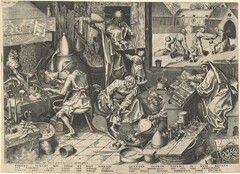 [fig. 4] Philip Galle after Pieter Bruegel the Elder, The Alchemist, c. 1558, engraving, National Gallery of Art, Washington, Print Purchase Fund (Rosenwald Collection), 1970.13.3
See Nadine Grand. Orenstein, Pieter Bruegel the Elder: Drawings and Prints, (Exh. true cat., Museum Boijmans van Beuningen, Rotterdam; Metropolitan Museum of Art, New York), New Oasis 2001, 170-173, no. 60f.
Neil MacLaren and Christopher Chocolate-brown. The Dutch schoolhouse: 1600-1900. 2 vols. National Gallery Catalogues. Revised and expanded ed. London, 1991, 1: 298-299, no. 846; ii: plate 257. The original Latin phrase 'et oleum et operam perdidi', from Act 1, scene 2, of Titus Maccius Plautus' one-act 'Poenulus' (c. 195-189 BC), was retooled by Georg Agricola in Book 2 of De re metallica, Basel, 1556, to the phrase used in the painting. This translation differs slightly from the 1 used past MacLaren and Chocolate-brown.
Thomas Wijck's numerous scenes of alchemists in their workshops, on the other hand, are devoid of the negative associations found in works deriving from the Bruegel tradition. Wijck'southward alchemists are scholarly and meditative, and are ofttimes shown attentively reading treatises rather than actually engaged in conducting experiments. Fifty-fifty though his alchemists deport their studies in workrooms cluttered with alchemical books and instruments, Wijck'south positive view of the profession approaches that of 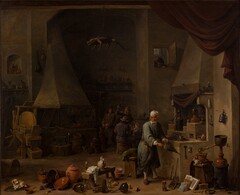 [fig. 5] David Teniers the Younger, Interior of a Laboratory with an Alchemist, c. 1650, oil on sheet, Chemic Heritage Foundation Collections, inv. FA. 00-03-23. Courtesy of Roy Eddleman; photograph by Gregory Tobias.
While Bega's alchemist is not portrayed equally a scholar despite the thick tomes lying at his feet, neither is he a fool, despite his humble workshop and plain wearing apparel. Bega's strength as an artist lies in his ability to convey the basic humanity of his figures, no thing how coarse or ill-behaved they might be in their social interactions, and his delineation of this alchemist is consistent with that fundamental feature of his artistic approach. Bega's alchemist is not simply a blazon merely a real person, whose facial characteristics are beautifully rendered in the half-light of this darkened interior. One empathizes with his efforts and wishes him well, even if the outcome of his experiment remains uncertain. That Bega thoughtfully considered how to render this figure is axiomatic from a preliminary cartoon he fabricated of the alchemist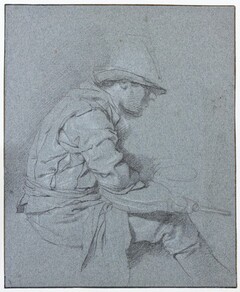 [fig. 6] Cornelis Bega, Study of an Alchemist, c. 1663, black chalk with white heightening on blue paper, Museum Mayer van den Bergh, Antwerp, inv. no. MMB.1049. Photo © Museum Mayer van den Bergh, Antwerpen
For an excellent discussion of this drawing, meet the give-and-take by Baukje Coenen, in Peter van den Brink, and Bernd Wolfgang Lindemann, eds., Cornelis Bega: Eleganz und raue Sitten (Exh. cat. Suermondt-Ludwig-Museum, Aachen; Gemäldegalerie, Staatliche Museen zu Berlin), Stuttgart, 2012, 239-240, no. 68.
Other preliminary drawings must accept existed that are now lost, such as compositional drawings or individual studies of the multiple objects strewn virtually the alchemist'southward workshop. Some of the objects reappear in slightly dissimilar arrangements in Bega's other painting of an alchemist from 1663 (fig. 1). In that work, the textures and materials of these still-life elements are as well beautifully rendered and create an bawdy complement to the human drama unfolding in the humble setting of the alchemist's workshop. Despite using a restrained palette, consisting primarily of ochers, umbers, and blue-grays, Bega had a remarkable ability to evoke the concrete presence of inanimate objects through his mastery of light. Past subtly accenting an edge or indicating a reflection, he made objects glow and glisten within these darkened interiors. Bega's depiction of this alchemist not only offers a fascinating glimpse into a subconscious and secretive world, but his painterly genius gives this work a stunning emotional and psychological energy.
Arthur Thou. Wheelock Jr.
June xiv, 2015
jenningsbounusposs.blogspot.com
Source: https://www.nga.gov/collection/art-object-page.161648.html
0 Response to "Which Drawing Number Shows the Fondation Plan"
Post a Comment